


The ring circuit or ring main as it is often called starts at the consumer unit and returns to the consumer unit. It can serve an area up to 120 square yards. It is normally protected by a 30 amp fuse or 32amp circuit breaker, it can have any number of sockets or fused connection units on it but the maximum load is 7200 watts. For this reason it makes sense to have three ring mains per house, 1 on the ground floor, 1 on the upstairs floor and 1 serving the kitchen alone, as this is where most of the high consumption appliances are. Please note that the circuit should be called a ring circuit, but most people know them as a ring main which is technically incorrect!
| Before working on any electrical circuit you must ensure that it is isolated correctly and cannot accidentally be switched back on. Please read the article on safe isolation procedures before doing any electrical work. If you are not 100% certain what you are doing call a qualified electrician. Building regulations are changing all the time and modifying your home electrics could be against new rules and could invalidate your home insurance, if in doubt check first! |
A typical ring circuit diagram would look like this-
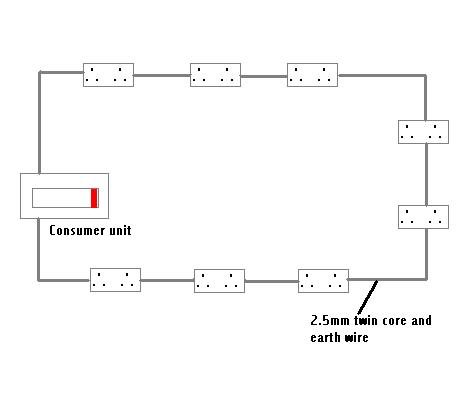
The 2.5mm2 wire starts at the consumer unit then runs from one socket to another and returns to the consumer unit.
The connections at the consumer unit would look like this-

Here you can see that Both cables from the ring circuit are both connected to the same terminals in the consumer unit, The two Earth wires connect to the earth block and the two Neutrals to the Neutral Bar and the two Live wires go into the same circuit breaker or fuse.
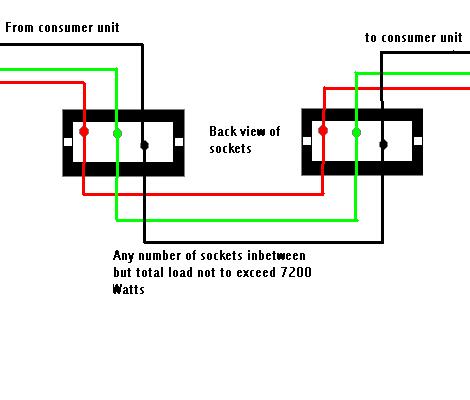
The connections at the sockets are pretty simple
HOW DO I KNOW IF I HAVE A RING MAIN OR RADIAL CIRCUIT ?
If you are unsure as to whether you have a ring circuit installed in your home you can soon find out pretty easily. Unplug any appliances which are plugged into the sockets. Isolate the main switch at the consumer unit and remove the fuse or switch off the MCB for the socket circuit. Follow the guidelines on the safe isolation procedure page, now remove the socket from the wall by removing the two retaining screws and gently move the socket clear of the back box. If there are three cables in the back box refasten it as this will make it difficult to test, you could assume that it is a ring circuit feeding a spur but you still need to test another socket. Find the next socket and test it is not live by plugging in an appliance you know is working, now remove the socket from the back box, hopefully this will have two cables in the back box. Undo the Live (RED) terminal and remove the two red wires, now using a multi meter switch it to OHMS and place one of the leads on each of the red wires or use a continuity tester, the meter should read Zero or very low resistance, some meters will emit a bleep also, this means that there is a circuit there and that it is a ring main!
If there is resistance present it means that you have a radial Circuit -

Diagram of a radial circuit
