


Rising damp can be a very debatable subject, there are some people convinced that it does not exist and that the companies making the damp proofing chemicals are encouraging people to inject their walls with damp proofing solutions that are not really necessary.
Rising damp occurs because the materials that we use to build our houses is permeable and so water from the ground can rise up through it in a process called capillarity, this means that the water can move upwards against the force of gravity. Below you will see a picture to demonstrate this process, in the picture a bowl has been filled with water and a building brick (commonly used in drier countries such as Spain and Cyprus) has been placed in the water. At first the water level on the brick was at the same level as that of the bowl, but a few hours later the water has risen considerably up the brick, this process is what makes rising damp possible in the right conditions.
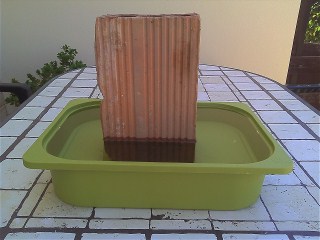
Brick placed in water
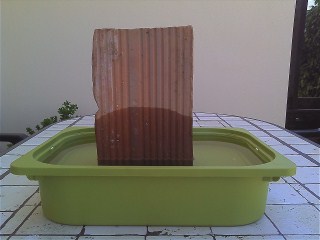
capillarity in action, this was after just 2 hours
Most houses built in the UK will of been built with some kind of damp proof course installed, this could be a row of slate, a row of engineering bricks or a layer of tar. Typically the damp proof level would be about 4 inches (100mm) above the ground level on the outside of the property. It is important to differentiate between condensation, penetrating damp and rising damp as treatment for each of the problems is considerably different. In some properties you may even have a combination of all three problems that needs fixing.
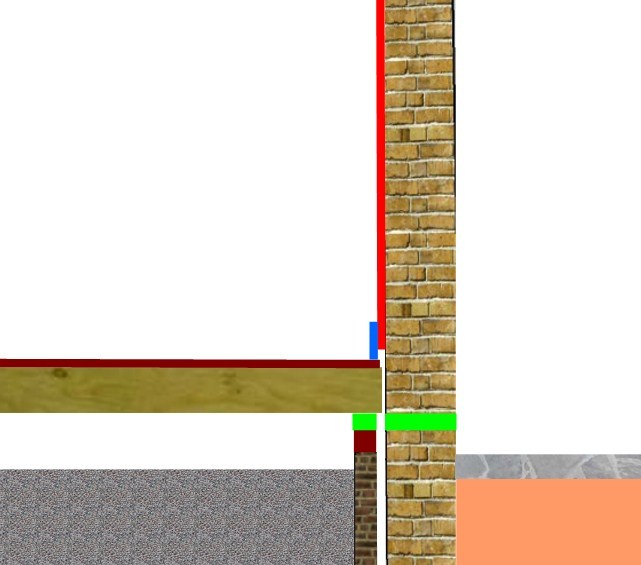 | This diagram shows how a Damp proof course could of been installed in an older property. You can see that the outside ground level is well below the level of the damp proof course. Key to pictures-
|


If the above property had remained in the same condition that it was built in it is unlikely that there would be rising damp in that property, but with the addition of external renderings or additional paving's outside it is possible that the damp proof course will be breached which can lead to rising damp.
Rising damp solid wall
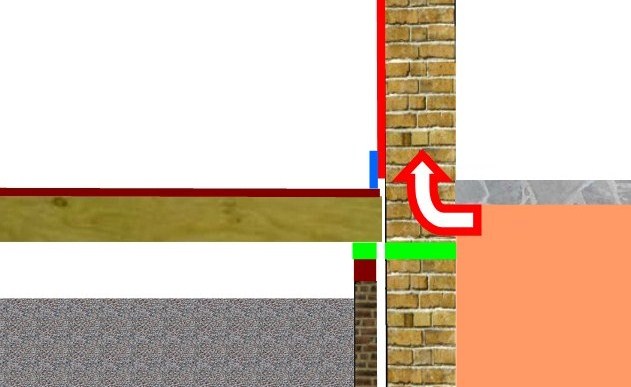
This image shows the path water could take to rise up from outside of the property to the inside of the property. Once the damp proof course has been bridged like this it is almost inevitable that there will be some rising damp in the property at some time, although it could take years for the damp to become visible in the property once the DPC has been bridged.
Rising damp cavity wall

Here you can see the path the water might take if the cavity was blocked in a cavity wall. This is quite a common problem and I have seen some cavities that have been two feet deep with debris. One way to remedy this problem is to carefully remove a brick or two and scrape out the debris from the cavity, but this should be left to a professional with the correct experience.
It is very uncommon for a damp proof course to fail in a property, so it is much more likely that it has been bridged or there was no DPC installed when the property was originally built. Once rising damp has been identified and all other possibilities have been ruled out you can then go about finding a suitable damp proofing solution.
