

PVA ( polyvinyl acetate ) is widely used when doing DIY, this emulsion has hundreds of uses and is readily available in most DIY shops or builders merchants.
PVA ( polyvinyl acetate ) is good for bonding paper, wood, leather, expanded polystyrene and most other porous materials to each other. But PVA is not suitable for gluing items that are susceptible to water or outdoor items as when it becomes wet it will re-dissolve and turn back to liquid PVA!
There has been some debate recently as to whether PVA should be applied to surfaces before tiling. If a coat of PVA is applied to the surface it creates a film of PVA. when the tile is stuck to the surface the tile adhesive will bond to the thin film of PVA and not the surface itself! If moisture gets behind the tiles, which is possible in a shower or similar then the thin coat of PVA could re-dissolve into liquid PVA, resulting in the tile falling off! It is important to follow the tile adhesives instructions and if it is not specified to use PVA then do not use it.
PVA as A priming agent
PVA ( polyvinyl acetate ) diluted 3 or 4 to 1 can be used as a priming agent. Mix the PVA with clean water and then brush it on the wall before plastering, rendering or papering. Priming the walls with diluted PVA before papering a bathroom is a very good idea as it stops the wall paper from peeling off!
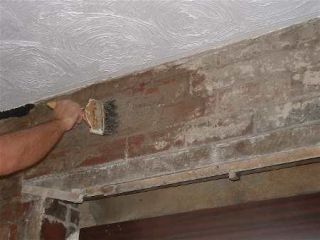
Here diluted PVA is being applied to a dry brick wall before it is dry lined using the direct bond method.
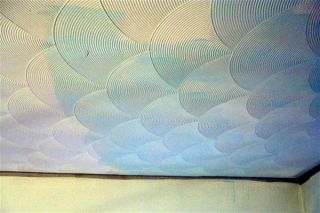
This ceiling is to be plastered over, to make it easier to see a small amount of food colouring has been mixed with the PVA so that you can see where you have applied it.
PVA as a Glue
PVA can be used as a wood glue as long as it is used inside. If you are using it outside you must get special External PVA wood glue. PVA is good for gluing wall paper borders and is often much cheaper than border adhesive, It is advisable to test a small area first!
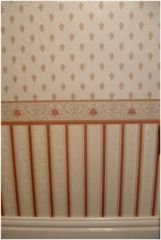
PVA can be used as a cheap alternative to border adhesive in most cases!
PVA as a Mortar additive
PVA diluted 3 or 4 to 1 can be used as a mortar admixture but the PVA must be external PVA and not internal. Mix the PVA with clean water and then use this as the gauging water for the Mortar. PVA greatly improves the workability of the Mortar and makes it stickier, this is very useful when rendering. Applying a coat of external PVA as a Priming agent will also increase the chances of the render sticking to the wall.
PVA in paint
I remember watching a TV program years ago where they recommended mixing PVA with some emulsion paint, if you are thinking of doing this there is a great post here about it PVA in Paint
