


If your tap is constantly dripping and will not completely stop the flow of water when it is in the closed position then the washer is probably damaged, or has perished and needs replacing. On most taps this is a relatively simple procedure and will cost a few pence if you do it yourself.
Most taps either use a washer or a cartridge to stop the flow of water, here are some examples of taps that contain washers-
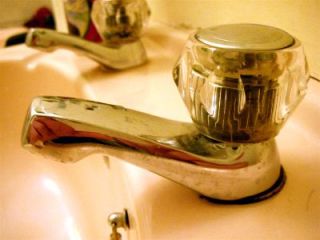
This is a very common type of basin tap and is found in many bathrooms.

This is a kitchen mixer tap. These are also very popular, although many are being replaced with modern versions that use cartridges and require only 1/4 of a turn to be fully open.
The two taps above look different, but they all work on the same principle and so changing a washer in any one of these taps is a very similar operation.
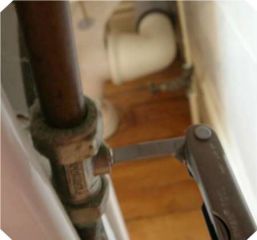
The first thing we need to do is to isolate the water supply to the tap. This can be done by turning the isolating valve beneath the tap (if there is one) or you will have to isolate the water supply to the whole house as described here- Isolate the water supply
After isolating the water open the tap to ensure that the water is isolated, then put the plug into the sink, so that no small parts can be lost.
Now we need to remove the tap handle so that we can expose the inner workings of the tap, this is slightly different for each tap and so a few examples are below.
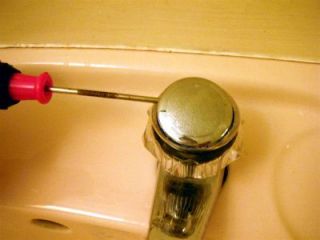
For the regular basing tap a small flat screwdriver is required, gently slide this underneath the tap cover and lift off the cover.
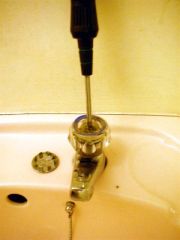
Now the screw that holds the handle onto the spindle is exposed it can be removed by turning it anti-clockwise. Once the screw is removed the handle will lift clear.
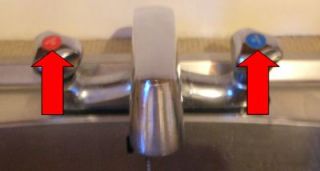
On the mixer tap you gain access to the retaining screw by removing the small plastic caps. A small flat precision screwdriver is best for this.
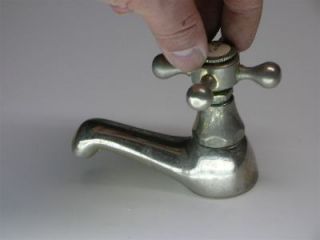
To gain access to the retaining screw on this model you need to unscrew the small cap on the top. This will normally undo with your fingers, if not you can wrap some cloth around it and then grip it with some suitable pliers.
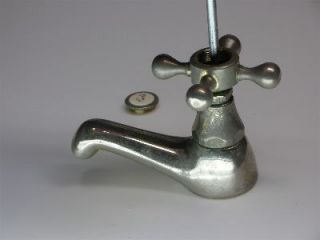
Once the cover is removed the retaining screw can be removed by turning it anti-clockwise.
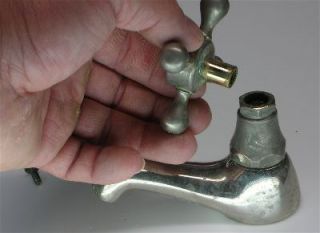
This handle has a spline fitting and this fits over the spindle on the head gear, which is also splined.
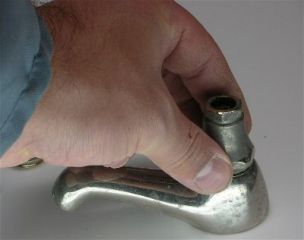
This fancy part of the tap is threaded onto a small thread and so requires undoing, this is normally only finger tight and can be removed by turning it anti-clockwise. If you cannot turn it by hand then wrap it with some cloth (to protect it) and then undo it using either a good fitting spanner or adjustable spanner. Never use a tool with a serrated edge on any fitting that has a decorative finish!
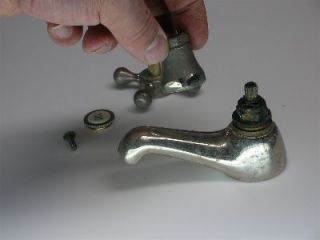
This cover can now be removed, exposing the head gear
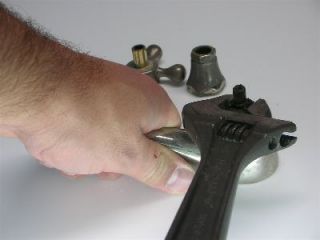
Hold the tap firmly in your hand and un-tighten the head gear nut, using wither the correct size spanner or an adjustable spanner. This will undo by turning it anti-clockwise.
Once removed check inside of the tap body and ensure that the seat of the tap is not damaged.
If the tap is difficult to hold wrap some cardboard around it and slide a box spanner over the spout for more leverage.
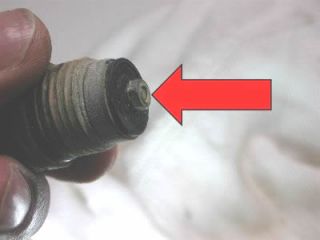
This is the tap head gear, the rubber washer on the end is held in place with a nut in this instance, sometimes it is simply a lug and the washer is merely pushed over the lug. Here we need to remove the nut and replace the washer. Most basin taps use an half inch washer and bath taps are normally 3/4 inch washers
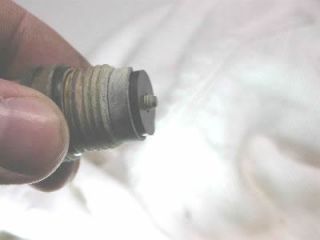
Once the nut is removed, fit a new washer and then replace the nut. Check the "O" ring at the top of the head gear as this needs replacing if it is damaged, or PTFE tape can be used.
Now screw the head gear back into the tap by screwing it clockwise, then tighten it up using either the correct size spanner or an adjustable spanner.
Replace the cover.
Replace the handle
Now replace the retaining screw and finally the cover.
Leave the tap in the open position and then restore the isolated water, this will flush out any debris from within the tap.
